![]() |
The
Hawk Conservancy Trust
|
|
Sarson Lane, Weyhill, Andover, Hampshire. SP11 8DY,
UK
Tel: +44 (0) 1264 773850. Fax: +44 (0) 1264 773772. Email info@hawkconservancy.org |
| About The Trust | · | About Birds of Prey | · | FAQ | · | Text size | · | Search | · | · |
We receive a very large number of enquiries at this site. Many of these are asking us to help with identification of a bird seen in some situation. We are happy to try to do this - preferably from a photograph, but a description can be enough when coupled with details of its behaviour and, importantly, location. If we don't even know in which country it was seen, that becomes quite tough. If possible, colour of eyes and feet can help, as well as details of plumage. Additionally, whether the wings, at rest, cross over, extend beyond the tail - that sort of thing.
Other questions include those below, which I have tried to answer here:
Are dogs permitted in The Hawk Conservancy Trust?
Can someone of less than 16
years take part in an Experience Session?
How long would a normal visit to the Trust take?
How close can we get to the birds? My son (age 10) is
keen to have one land on his arm.
When is a good time to take an Experience Session, and
when is a bad time?
What is the music played at the 2pm Valley Of the Eagles display?
What are the restrictions on photography if not on a Photographic Day?
Is there somewhere to eat at the Trust, and can I bring in my own picnic?
Is the Trust accessible?
Can you print info from your
article?
How can I stop hawks from feeding
on my garden birds at the feeder?
How can you tell the difference
between a male and female peregrine falcon?
How do I get started in Falconry
- I live in the UK?
I am interested in finding out the legends of the hawk.
I recently found a baby hawk in my yard. Its mother has
kicked it out of the nest. I have had it about 3 days and it has stopped eating.
It will not even stand up on its own. What should I do?
Is there a name for a male hawk?
What are the enemies of hawks?
What is the correct name for
a baby hawk?
Why do so many vulture species have a feather 'collar'
around their necks?
Why do so many vulture species have a feather 'collar'
around their necks?
The ruff is there to keep the rest of the body clean and dry, to act as a sponge to help prevent the all-important flight feathers from becoming caked with blood.
Carl Edelstam, in Raptors of the World (see http://www.hawk-conservancy.org/bibliography.shtml for details) says 'a bald head and a naked neck make for poor heating economy in cold surroundings. Therefore, vultures living at high latitudes or in montane regions have a thick downy collar into which the neck can retract at rest and in flight.'
What are the enemies of hawks?
I think the first thing we need to do is to get away from the concept of enemies. That is a human concept, based mostly on our unique capacity for irrational hatred and greed. No other creature has these ideas.
Birds of Prey are pretty much at the top of the food chain. Some smaller birds of prey are occasionally predated upon by larger birds of prey and, in a few species, it is not unknown for a female to kill and consume a male of the same species. Virtually all predators are opportunists, however, and will take the easiest meal available, making use of their particular adaptations.
Only the falcons and some accipiters are designed to take other birds in flight, as this requires a particular speed and agility of flight to accomplish. Ground quarry is usually much easier and, of course, carrion is easier still. Thus a sick or injured hawk on the ground, or one simply eating its catch on the ground is at risk not only from larger birds of prey above it, but more likely from ground predators and road traffic.
Generally, though, like most animals,
the creature they must fear most, and with very good reason, is man. We are
the only species likely to harm another creature for no rational reason (which
probably makes us the natural 'enemy' of just about every species on the planet,
except those we have domesticated). Domestic cats are also a threat to individual
birds, but they have never, to my knowledge, driven any species to extinction!
TOP
How do I get started in Falconry - I live in the
UK?
You need to attend a course to learn about what is involved in caring for and flying a Bird of Prey. The
British Falconers Club web site will be able to help.
TOP
Is there a name for a male hawk?
It varies from species to species and from place to place.
Native to this country, the male sparrowhawk is called a musket. The
male goshawk has no special name that I know, neither do the Buzzards, Eagles
or Harriers. Some of the falcons do - the male Peregrine is generally known
as a Tiercel or Tercel, the male Merlin is known as Jack and
the male Hobby as Robin (but not by everyone). Further afield, the
male Lanner Falcon is a Lanneret, and the male Saker Falcon a Sakeret or Sakret.
TOP
When is a good time to take an Activity Day, and
when is a bad time?
There is no good or bad time for the Experience Session as whatever time of year you attend the day is pretty much the same. Bad weather makes it harder to have a good time, and really foul weather can result in a postponement.
For myself, I prefer summer. There is a better chance of good weather, the downland meadow is gorgeous and, if it's not too hot and there's a light breeze, the birds fly splendidly. Late April and May can be good if there are a lot of young about.
Whenever you do it, you will have a memorable day, have a lot of fun and learn
about the work of the Trust.
TOP
How can you tell the difference between a male and
female peregrine falcon?
The main difference between the male and female Peregrine Falcon is in size.
Throughout much of nature, the male of the species is larger than the female.
This is known as sexual size dimorphism. Many birds of prey exhibit reverse sexual
size dimorphism, which means that the female is larger than the male.
One of the traditional names for the male Peregrine is Tiercel or Tercel. This is believed to have come from old French for third (as a fraction), and reflects the fact that the male Peregrine will be about one third smaller than the female. He will also be of slighter build and have correspondingly narrower wings. The average weight of a wild male of the European race is 550g-750g against the female's 740g-1,300g.
The female sometimes displays heavier barring than the male, especially around the flanks, but given the variations that are possible anyway, this is probably not a good diagnostic.
Can you print info from your article?
You probably have a print button on your browser that will do that for you
TOP
How can I stop hawks from feeding on my garden birds
at the feeder?
You would be surprised to learn how many emails I receive, essentially saying,
'I like hawks, but not in my back yard'
Unfortunately, I only know of one solution, and no-one likes it, but here it is. Discourage the prey, and the predator will have no cause to come. However we all want to feed our wild birds, and we should feel very privileged to see the full cycle of nature. We are in affect creating a takeaway in our back garden.
A deterrant may be to place a feeder in a protected position e.g. close to a hedge, allowing the birds some protection. It is, however, a fact of nature that the hawk needs to eat to survive, as much as the small birds do.
Are dogs permitted in The Hawk Conservancy Trust?
Dogs are not permitted inside the Park, with the exception of registered assistance dogs. There are shaded areas of the car park set aside for vehicles containing dogs, and you are at liberty to move between the Park and the car park as often as you wish, in order to keep an eye on your animal(s)
TOP
I recently found a baby hawk in my yard. Its mother
has kicked it out of the nest. I have had it about 3 days and it has stopped
eating. It will not even stand up on its own. What should I do?
It is unlikely that the parent birds have ejected it from the nest. If they
have, it will be because it is not viable. However, it may have accidentally
fallen from the nest or, more likely, from a branch where it was standing,
in which case the parents may will still be taking care of it. The best advice,
therefore, is to leave it alone. If the bird is in a dangerous location, such
as on a road, and if you can safely put it back into its nest, then there is
no harm in this as raptors do not have a sense of smell and will not know of
your intervention. If you are unable to do this, just put the chick on the
nearest branch to the nest that you can reach. If the chick continues to fall
out of the nest, or there appear to be no parents caring for it after a couple
of days then you may need to take alternative action.
Unless you know exactly what you are doing, hand-rearing any very young wild animal can render it incapable of surviving in the wild later. One of the most important defense mechanisms any animal has is an instinctive fear of humans. It is potentially disastrous for any animal to lose this, and worse still, to come to regard humans as food suppliers. The best advice I can give to you is to get the bird immediately to a rehabilitator. They are trained in rehabilitating birds, and the youngster may even be foster reared by another Bird of Prey. If you don't know your nearest, the Police should. If they don't, in the USA the Fish and Wildlife Service certainly will. Failing that, try the Wildlife Rehabilitation Information Directory.
Can someone of less than 16 years take part in
an Activity Day?
Yes they can. We have set up two special hands-on experience
taster sessions for children. These are children's owl experience and Junior
Falconer experience, using specially selected birds of prey. Please return
to the home page of website for more information.
What is the correct name for a baby hawk?
I am usually comfortable with 'chick' for all young birds. However, terms that have been used include eyas/eyass, although some dictionaries say this is only for falcons, some say only for hawks and not falcons, and some say only by falconers.
Useful sources include:
http://www.co.fairfax.va.us/library/Faq/animal.htm
http://www.enchantedlearning.com/subjects/animals/Animalbabies.shtml
http://www.doghause.com/funfacts01.html
http://www.indianchild.com/babyanimalnames.htm
TOP
How close can we get to the birds? My son (age
10) is keen to have one land on his arm.
After at least two displays each day, children are encouraged to hold a British
bird of prey. An important condition, however, is that they can correctly identify
the bird they are holding, and they must not stroke the bird.
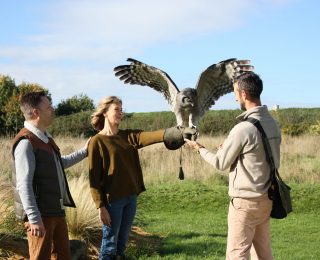
If your child would like to get closer to Birds of Prey and experience specially selected birds flying to their fist under the guidance of experienced staff please view the details of our children's owl and junior falconer experience sessions.
I am interested in finding out the legends of the
hawk.
There are many sites on the web that deal with legends, myths, fables and folk-lore,
but I'm afraid we are not one of them.
A search at google.com for hawk legend should be a good start point.
What is the music played at the 2pm Valley Of the Eagles display?
The music that is played to the Black Kites entering the arena is the theme tune from the film Dances with Wolves.
Our Bald Eagles return to the Valley of the Eagles arena to the title track of Vangelis' album 1492 - Conquest of Paradise.
CD's featuring both these tracks are generally available in our Trust Shop
What are the restrictions on photography if not on a Photographic Day?
No real restrictions at all. From a safety point of view it is not permitted to climb over any fences or barriers to take photographs. From a common courtesy point of view it is best if you don't fall prey to the temptation to push forward to the best position or stand during a flying demonstration just because you have a video or still camera and want to get the best image you can. Unfortunately, that generally results in other people's enjoyment being spoiled.
We ask that if you wish to publish your photographs, full credit be given to the Hawk Conservancy Trust. If you wish to use your photos for commercial purposes, please ask permission of the Trust first. We would also ask that you consider making a donation of a percentage of any profits made, towards the work of the Trust. If photos are commissioned for commercial purposes a charge may be applied by the Trust for their use.
How long would a normal visit to the Trust take?
In my experience most visitors stay for between 4-5hrs. Many are surprised at how much there is to occupy their time at the Trust, often thinking they will spend an hour or so here, and ending up not leaving until 5.30pm!! Our activities start at 11.30 with our vulture restaurant, 3 displays at 12 , 2.00 and 3.30 each in a different location and featuring a different team of birds, and the day ends with our Red Kite feed at 4.30pm, and often lots more in between. For full details of a normal days timetable at the Trust, visit our Whats On daily timetable section( remember at weekends and school holidays there are often extra activities available).
Is there somewhere to eat at the Trust, and can I bring in my own picnic?
Yes Duffy's coffee shop has a wide selection of hot and cold food and drinks, including full English breakfasts, filled sandwiches and baguettes, homemade soups and a hot dish of the day for lunch, and a range of mouthwatering home made cakes. During weekends and holidays (weather permitting) we also have a lunchtime BBQ, and outlets around the grounds selling cold drinks and ice creams. Don't forget for special occasions you can pre-book a picnic or afternoon tea in our wildflower meadow.
You are more than welcome to bring your own picnic to the Trust, and we have several picnic areas around the ground including a covered patio area for any inclement weather. You do not need to carry your picnic around with you, use your pass out ticket to go out to your car as you wish.
Yes. The Trust is fully accessible with flat tarmac paths around the whole of the grounds, and no steps or stairs in any of the public buildings. There are plenty of seats for rest breaks, and manual and powered scooters are available for hire. For full details of our facilities for disabled visitors please visit the disabled facilities section of the website.
| Home | | Ticket Shop | | contact us | | legal | | privacy | | bibliography | |
|
Charity No: 1092349 - Company No: 4304161
|
|||
Copyright © 1996-2008 Keith Channing
and The Hawk Conservancy Trust, Andover, Hants SP11 8DY, UK. All rights
reserved.
Tel: +44 (0) 1264 773850. Fax: +44 (0) 1264 773772.
Email info@hawkconservancy.org.
Click here for open dates and times, ticket
prices and directions and a map showing our location .
All data, images etc. owned by the author or by The Hawk Conservancy Trust will be freely available for any non-commercial use, subject only to their being unchanged and to credit being given to the photographer and to The Hawk Conservancy Trust. A few photographs are gleaned from other resources and in some cases we have not been able to identify the copyright owner. In these cases, if notified, we shall be more than happy either to give credit for the work, or remove the offending images and acknowledge our error.