



If you’ve ever spent time watching owls, be that in the wild or in human care, in the UK or overseas, one of the things you’ll no doubt notice is just how different their eyes can be. At the Hawk Conservancy Trust, we have some wonderful examples. Sweeney Todd, our Snowy Owl, has striking bright yellow eyes that seem to glow against her white feathers. Molly, our Eurasian Eagle-Owl, stares out with vivid orange eyes, while Troy, our Tawny Owl, has deep, dark brown eyes.
So why are they so different?
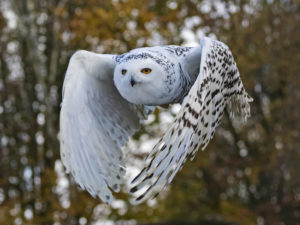
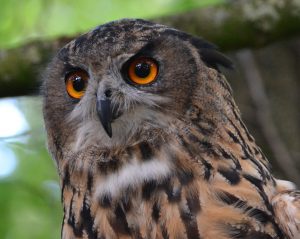
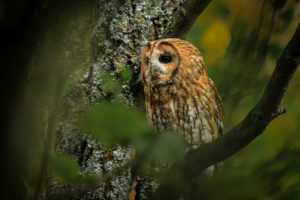
For years, one of the most common explanations has been that an owl’s eye colour reflects when it is most active. The theory suggests that owls with yellow eyes are adapted for brighter conditions and tend to hunt during the day, orange-eyed species are most active at dawn and dusk (crepuscular), and dark brown or black-eyed owls are specialised for hunting at night because their eyes absorb more light.
It sounds neat and tidy, but nature rarely is.
The truth is that we don’t actually know for certain why different owl species have different eye colours. While the popular theory has some appeal, there are simply too many exceptions for it to be considered a definitive explanation.
For example, one study found that almost 60% of owl species considered strictly nocturnal have dark irises. That might seem to support the theory, but it also means that more than 40% of nocturnal owls don’t fit the pattern. Likewise, nearly 30% of owl species that are active during the day or at dawn and dusk also have dark eyes.
It’s a bit like the old spelling rule many of us learnt at primary school: “I before E except after C.” It’s a useful guideline until you discover there are so many exceptions that it quickly falls apart. Owl eye colour appears to be much the same – perhaps an interesting trend, but far from a universal rule.
That said, there may be some evolutionary clues.
Researchers have suggested that changes in an owl’s activity pattern over evolutionary time may have influenced changes in iris colour. This idea appears to hold up a little better when looking at the two main owl families.
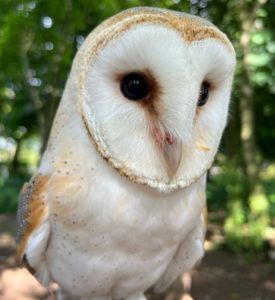
Willow the Barn Owl
The Tytonidae family, which includes Barn Owls and Bay Owls, consists almost entirely of nocturnal species, and they all have dark eyes. In contrast, the much larger Strigidae family, which includes almost every other owl species, displays a remarkable variety of eye colours alongside a wide range of activity patterns.
Even within the UK’s owl species, however, there are exceptions. Tawny Owls and Long-eared Owls are both predominantly nocturnal, yet Tawny Owls have dark eyes while Long-eared Owls have bright orange eyes. Then there’s the Little Owl, with its pale yellow eyes, which seems to fit the traditional theory by being partly active during the day, but it is also perfectly capable of hunting at night.
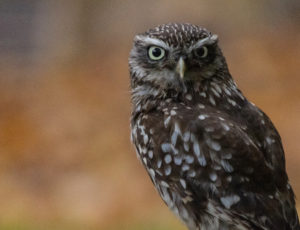
Mozzarella the Little Owl
So, if activity patterns don’t tell the whole story, what else might explain these colourful eyes?
Across birds in general, eye colour is often thought to have evolved for one of two main reasons: to improve survival or to communicate information to other birds.
The activity-pattern theory falls into the first category, suggesting eye colour provides an advantage in different lighting conditions. Another possibility belongs in the second category.
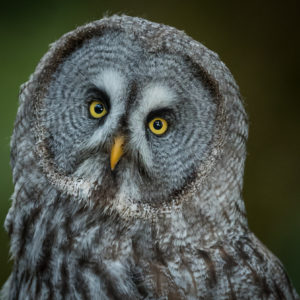
Walter the Great Grey Owl
In some owl species, scientists have suggested the pigments responsible for yellow and orange eye colours are influenced by compounds obtained through their diet. If that’s the case, the richness of an owl’s eye colour could potentially reflect its health or, in breeding birds, a parent’s ability to find enough food to raise its young successfully.
However, once again, this is unlikely to be a universal explanation. It may apply to some species, but certainly not to all.
In the end, owl eye colour remains something of a mystery. While researchers continue to investigate the role of evolution, behaviour and diet, there is still no single explanation that works for every species.
So next time you meet Sweeney Todd, Molly or Troy, take a moment to appreciate their remarkable eyes. They may be different shades, but each one is a reminder that nature often refuses to fit into the neat little boxes we’d like to create.
If you want to hear more then check out this episode of the Trust’s Nature’s a Hoot podcast, hosted by Tom Morath, investigating more about owls, their head turning and their eyes!