



X

Picky Vicky & Othello: The Fish Eagles Working with Hugo

Posted on: by

For Bird Team member Hugo, working with African Fish-Eagles has been a long-held ambition. Ever since visiting the Hawk Conservancy Trust at the age of eight, Hugo watched Othello soar overhead and imagined what it would be like to one day fly one of these striking, impressive hunters himself. Years later, that dream has become a reality, as he now works closely with two of our very different African Fish-Eagles: Othello and Victoria.

The Challenge of Othello

Othello, our male African Fish-Eagle, has quite a reputation among the Bird Team. Intelligent, opinionated and selective about who he chooses to work with.  Currently, only a small number of the team have been selected to work alongside him!

It is important with our choosey birds, like Othello, that we work to try and build up a relationship with other members of the Bird Team, should his favourites move on.  Hugo was delighted to have the opportunity to work to develop Othello’s trust and form a bond.  Hugo started slowly, offering food from the glove inside the aviary and allowing trust to develop naturally.

Fortunately, Othello was surprisingly receptive.

“He came straight to me,” says Hugo. “I’d worked with him a little before and fed him over the years, so he already knew who I was.”

From there, the partnership grew steadily. What began as simple feeding sessions led to flying demonstrations, and eventually Hugo became one of the select few trusted to work with Othello.

Today, Othello sits firmly near the top of Hugo’s list of favourite birds.

“He’s a really cool bird,” he says. “We shouldn’t have favourites, but he’s definitely up there.”

Enter ‘Picky Vicky’

If Othello has a reputation for being selective, Victoria takes things to an entirely different level.

The female African Fish-Eagle has lived at the Trust for many years and, for most of that time, Cedric, Senior Bird Team Member, has undoubtedly been her favourite. Victoria has always been very particular about who she chooses to work with.

“She’s definitely a more nervous bird” Hugo says.

When Cedric went on holiday, Hugo was given the opportunity to start working with her. It began with something seemingly simple: weighing her.

Armed with a video tutorial from Cedric and plenty of patience, he slowly encouraged Victoria to approach the scales. Initially, it took a while. Then it came down to a few minutes, and eventually it became routine.

The next challenge was encouraging her to come to the glove.

Rather than rushing the process, Hugo worked to build her confidence step by step. At first, she was simply rewarded for approaching. Then she learned to take food while standing on the glove. Gradually, trust developed between bird and Bird Team member.

“It was just lots of small steps,” he explains.
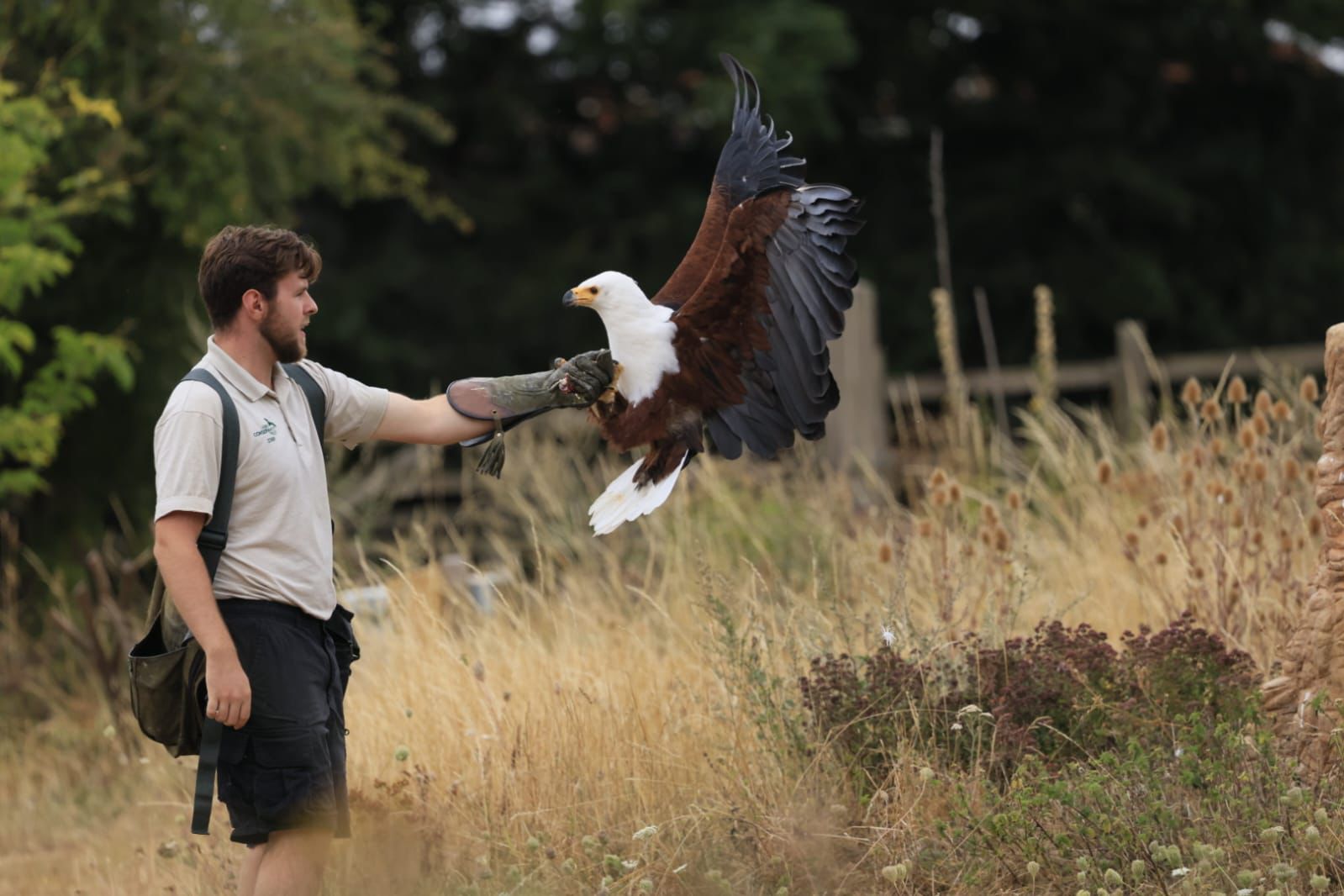
First Flight

Eventually, the day came to see whether all that trust-building would translate into flight.

After waiting for suitable weather conditions, Hugo finally offered Victoria the opportunity to fly. While the first experience wasn’t completely smooth, it was hugely encouraging.

Victoria decided against her intended route and landed in a nearby meadow, where Hugo calmly called her onto the glove before walking her back.

“It was nerve-racking,” he admits. “She just stared at me for the entire walk back.”

But she stayed put, trusted him throughout, and proved that the partnership was beginning to work.

Since then, Hugo and Cedric have shared Victoria’s flying duties, helping her become more amenable to working with different people.

The Power of Fish Eagles

Both Othello and Victoria embody the qualities that make African Fish-Eagles such extraordinary birds. They are powerful, intelligent and highly individual animals, each with their own preferences, habits and quirks. Known as the “Voice of Africa” because of their iconic, far-carrying call, they are among the continent’s most recognisable birds of prey.

Years after first watching these majestic birds as a child, Hugo now stands in the arena with them at his side, earning their trust one flight at a time. And for a species known for being selective, that trust is a true compliment.
A Fond Farewell to our Interns

Posted on: by

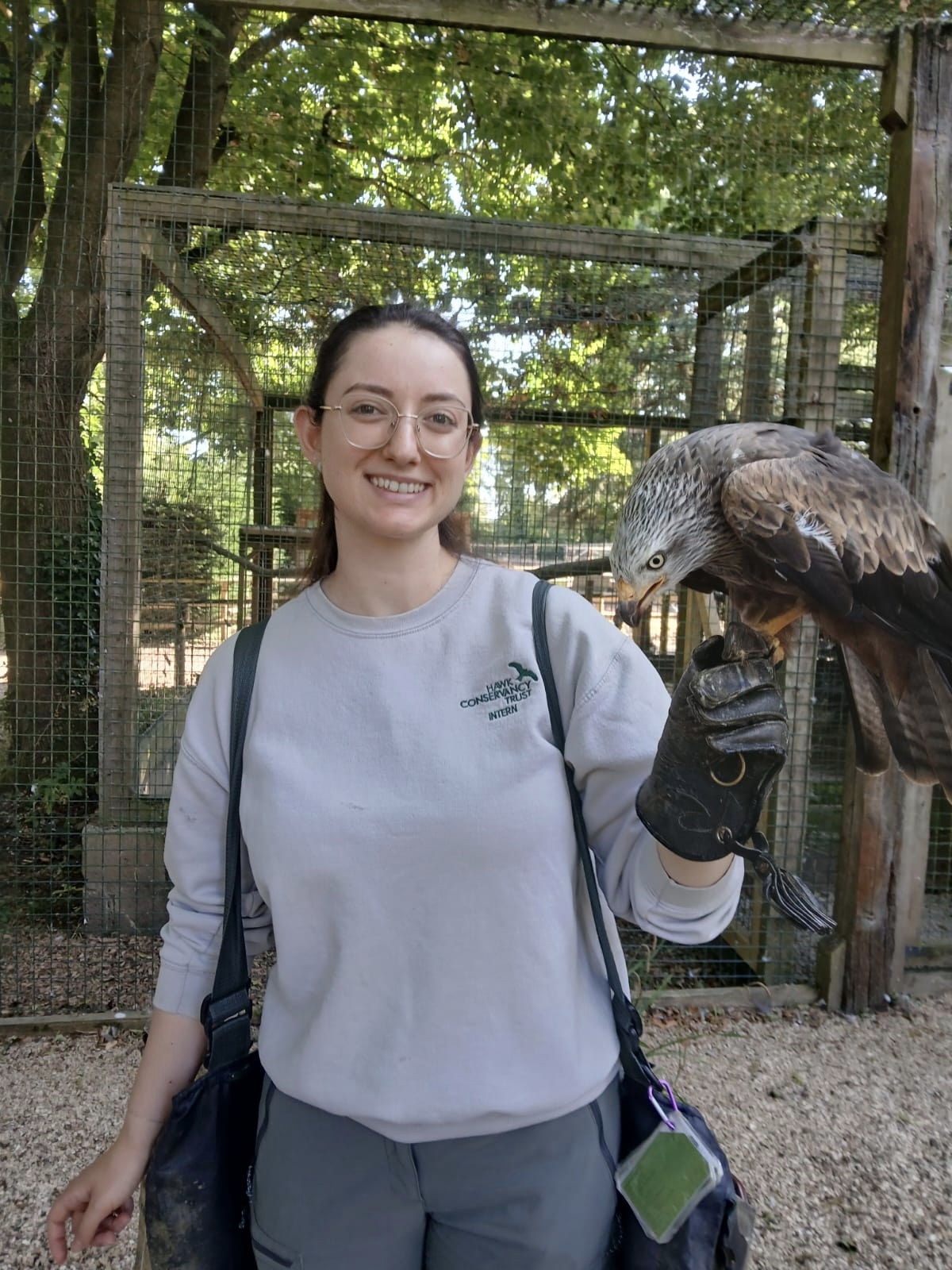
As Summer 2026 draws to a close, we are saying a fond farewell to our wonderful interns, Alice and Kristina. Over the past few months, Alice has been a valued member of the Conservation and Research Department, while Kristina has brought enthusiasm and creativity to our Education and Marketing teams. Their hard work, fresh perspectives, and positive contributions have made a lasting impact across the organisation, and we are incredibly grateful for all they have achieved during their time with us. We wish them every success in their future endeavours and look forward to following their exciting next steps.

Alice’s experience at the Trust

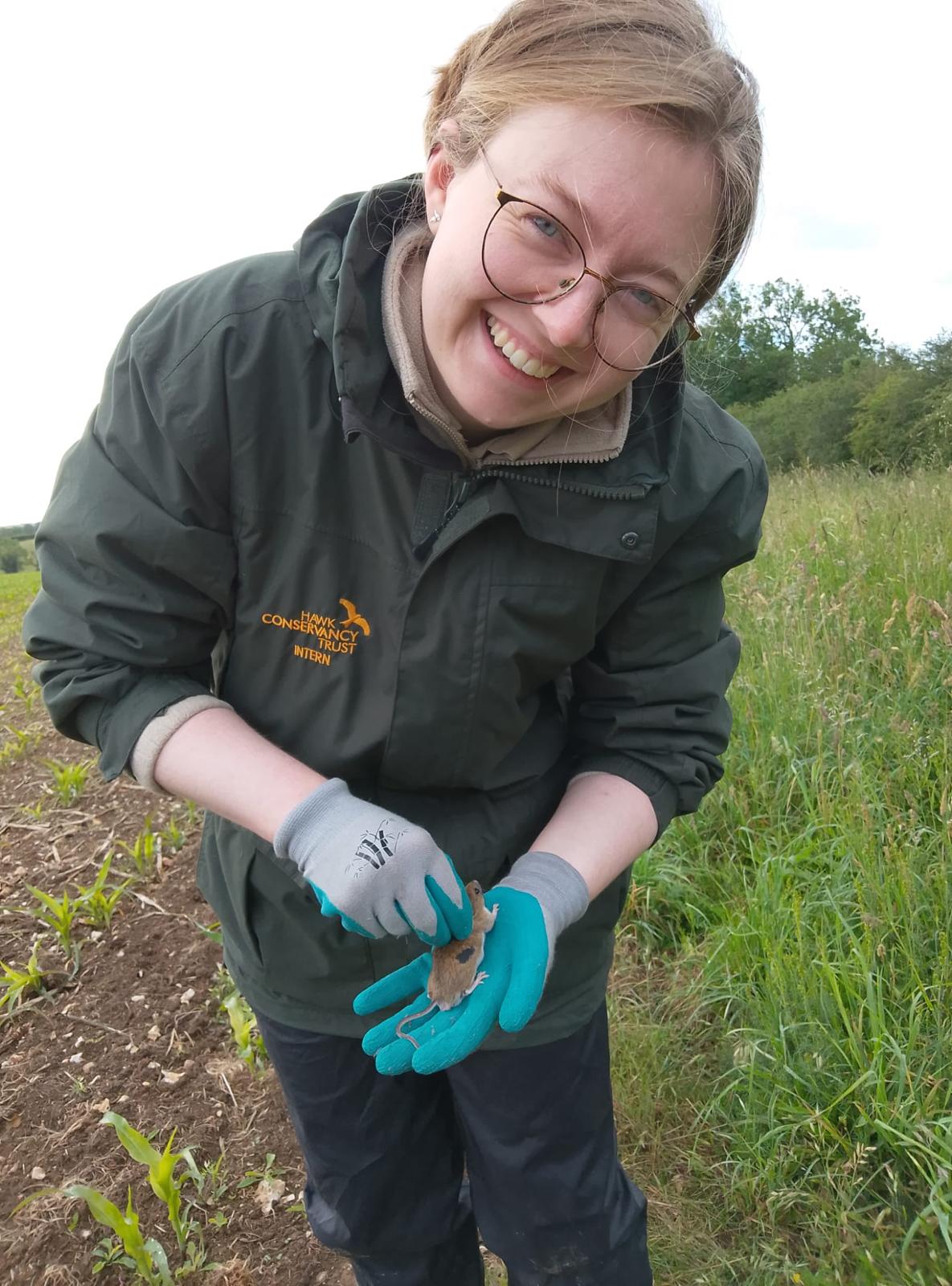
Since starting as the Conservation and Research intern at the Hawk Conservancy Trust in June, I have had an action-packed start to my career in conservation!

Monitoring the onsite biodiversity on site at the Trust has been one of my favourite aspects of my time here! I have been able to see and survey the amazing birds on site, including Barn Owls and Corn Buntings, completed bat surveys (with a Leisler’s bat recorded!), investigated the many plant species on site and even seen badgers on camera traps! While I came to the Trust with birds as my favourite, I’ve absolutely loved monitoring the butterflies and day-flying moths on the site this year, with 39 species recorded at the Trust so far! Seeing Reg’s Wildflower Meadow ‘sparkle’ with so many butterflies was beautiful and I’ve seen so many I could name favourites, such as Clouded Yellows and Marbled Whites! Discovering the beautiful moths flying at night at the Trust has also been amazing – including my first ever Poplar Hawk Moth! Learning from volunteers at moth trapping mornings and then sharing my newfound knowledge at the Big Wild Weekend in August has been so amazing and I am very grateful!

I’ve also had the opportunity to get involved with the Trust’s Conservation and Research projects, particularly getting involved in a Small Mammal Surveying project off-site investigating prey populations! Tanith, the Research Assistant at the Trust, has taught me so much about small mammals and we have had an incredibly busy time handling lots of Wood Mice, Common Shrews, tiny Pygmy Shrews, feisty Yellow-necked Mice, a Water Shrew and my favourites, the Bank and Field Voles! My knowledge of small mammals has improved dramatically, and I have loved the opportunity to be able to see so many of these beautiful mammals up close in my hand thanks to Tanith’s guidance! As part of the British Raptor Project, I’ve also had the opportunity to handle bird of prey species in the field under the close supervision of Dr Matt Stevens, helping to ring my first ever Tawny Owl chick, and mapped habitat and monitored GPS tagged Kestrels as part of the Kestrel Conservation Monitoring Project. I have also been out to set camera traps as part of the Raptor Risk Map project! Being out and about in the field has allowed me to be constantly surrounded by wildlife, with highlights including nesting Barn Swallows, following so many Humming-bird Hawk Moths and even seeing a sunset-lit Goshawk!

As a visitor to the Hawk Conservancy Trust for many years and the place that genuinely sparked my journey into conservation, my time spent at the Hawk Conservancy Trust has been a real privilege and a lot of fun! I have had the opportunity to meet lovely volunteers and am incredibly thankful to my supervisor, Dr Jamie McKaughan, and everyone at the Trust for supporting and teaching me throughout my internship!

Kristina’s experience at the Trust

It is hard to believe that my internship at the Hawk Conservancy Trust has come to an end. I arrived hoping to gain practical experience in conservation education, but I am leaving with so much more – new skills, greater confidence, wonderful memories and an even stronger certainty that this is the field I want to build my career in.

Working at the Trust has given me the opportunity to experience many different sides of conservation education. I have supported and taken the lead in delivering school workshops, created educational resources and developed activities for events including Dream Night, Big Wild Weekend, Art Weekend and International Vulture Awareness Day. One of my biggest projects was developing the Nature Explorers Challenge – an interactive addition to the Trust’s Tree Trail. I was able to take the project from the initial idea through design and implementation to collecting visitor feedback, analysing the results and making recommendations for its future development.

Big Wild Weekend was another highlight. I developed activities and resources showcasing the Trust’s conservation work, including the Raptor Nest Box Project, small mammal surveys, moths, pond life and owl pellets. Seeing visitors engage with activities I had spent weeks developing and having conversations with them about the conservation work behind them, was incredibly rewarding.

I have also been lucky enough to step outside education and experience some of the practical conservation work happening at the Trust, including small mammal, moth and bat surveys.

What I will take away most, however, is how much I have learned from the people around me. This experience has given me the freedom to be creative, challenged me to try new things and helped me grow in confidence as both an educator and conservationist. I am incredibly grateful to everyone at the Trust who shared their knowledge, supported my ideas and made me feel part of the team.

Hovering on a myth… help truth take flight!

Posted on: by

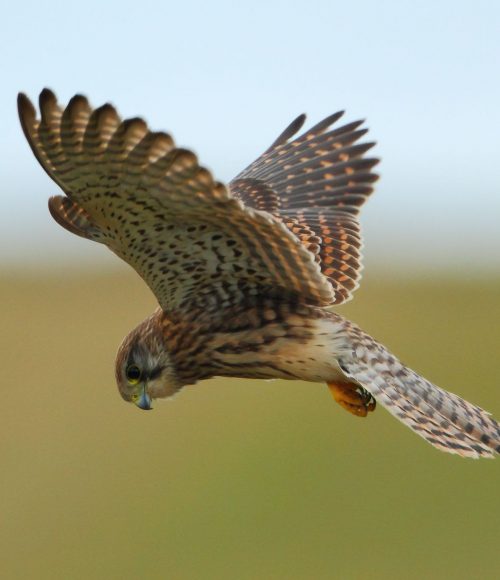
Dr Jamie McKaughan, our Conservation and Research Coordinator, cracks open the myth surrounding Kestrels and how they hunt their prey, separating fact from fiction and revealing what the science is really telling us…

When better evidence comes along, it should update our knowledge and our thinking, but sometimes our collective memory does not always keep pace, or perhaps the new evidence does not get the public spotlight it should – another discussion for another time perhaps!

Nonetheless, ideas that have never been properly demonstrated, tested or proven can become so deeply embedded in popular understanding that years of repetition give them an authority they never earned, sometimes even allowing them to survive a robust scientific study that has directly challenged or disproved them. The result is a strange inversion: common belief being more persistent than empirical evidence. Even if you ask an AI system, it is likely these very same inherited assumptions are confidently repeated rather than any reflection or credence given to the robustly tested published research that overturned it…

So, where am I going with all this?! There are many examples of this scenario regarding wildlife, but a prime example comes in the form of Kestrels, and the idea that they use urine trails to help them hunt their prey – 100 percent, right? Wrong! A piece of research by Olle Lind and team set about testing this theory properly, with their comprehensive results published in 2013, coming up on 15 years ago now…


This myth originated from two circumstantial pieces of information being put together with an assumption they were related without ever being tested… Point Number One – birds’ vision is sensitive to UV light and point Number Two – a finding from Finland that urine of Finish voles reflects UV light.

Let’s break those two points down… are they even true and are they actually related?

Let’s start, logically, with point Number One – birds’ vision is sensitive to UV light. We widely accept that many birds are what are called tetrachromats, where they possess a fourth specialised cone type in their eyes that detects ultraviolet or violet wavelengths of light. For comparison, humans are trichromats, possessing only three types of colour-receptive cones in our eyes (blue, green and red). The extra colour-receptive cone that many birds have allows them to experience a world of colour humans cannot perceive. As the feather structures of many bird species also reflect light in the ultraviolet or violet range and because many birds can discriminate this greater variety of colours than humans it is likely that birds will appear quite differently to each other than they do to us. So, part one of our myth, thus far, is giving truth vibes… However, that is just part of the tale…

The 2013 study that disproves this entire myth tested the specific wavelengths of light that actually make it to the retinas of several species of raptor. Before light hits the retina, it is filtered through the cornea, the lens and the fluids in the eye, all of which could impact what amount and/or wavelengths of UV actually reach the retina – something their research showed to be true. They found that a lot of UV light was filtered out, with only much higher wavelengths reaching the retina. As such, in order for Kestrels to be hunting voles by following their urine trails they would need the vole urine to be reflecting the higher wavelengths of UV light…

So, what wavelengths might vole urine be reflecting if any?…

To address point Number Two – that urine of voles reflects UV light – the same 2013 study tested the amount of UV light that vole urine reflected. In a contrast to the idea from many years before that Finish vole urine reflects UV light, their findings showed there was very little if any UV light reflected, with many other studies also studying mammalian urine and finding no UV is reflected, with it effectively appearing the same as water would – pretty robust and conclusive! If there is no UV being reflected by vole urine (which there isn’t!), Kestrels cannot be using it as a means to hunt said voles!

So, despite the long-standing claim that Kestrels use vole urine trails to locate their prey being a compelling ecological story that has persisted in popular and even scientific discourse for decades, and a narrative that still seems to remain, it is not true! Now we just need to dispel this commonplace myth more widely… If you hear someone saying that the Kestrel’s superpower is hunting voles by following their UV-reflecting urine trails, be sure to let them know this is not true… science says so!

My final reflection is about how we perceive species and their ‘value’… I often hear Kestrels being hailed as awesome because of this mythical hunting superpower, and it strikes me as curious that we would think their achievements are more awesome because of this supposed ability than without it. If anything, I think they become even more wondrous by being able to hunt successfully in the way they do in the absence of this ‘special ability’ in their arsenal… They are super enough as they are and that is just one reason we are working so hard to conserve them!

©2026 Hawk Conservancy Trust