


X

A Growing Partnership: Poppy and Phoebe Take Flight

Posted on: by

From cautious first introductions to captivating visitors in our displays, discover how Bird Team member Poppy built a special bond with Harris’ Hawk, Phoebe.

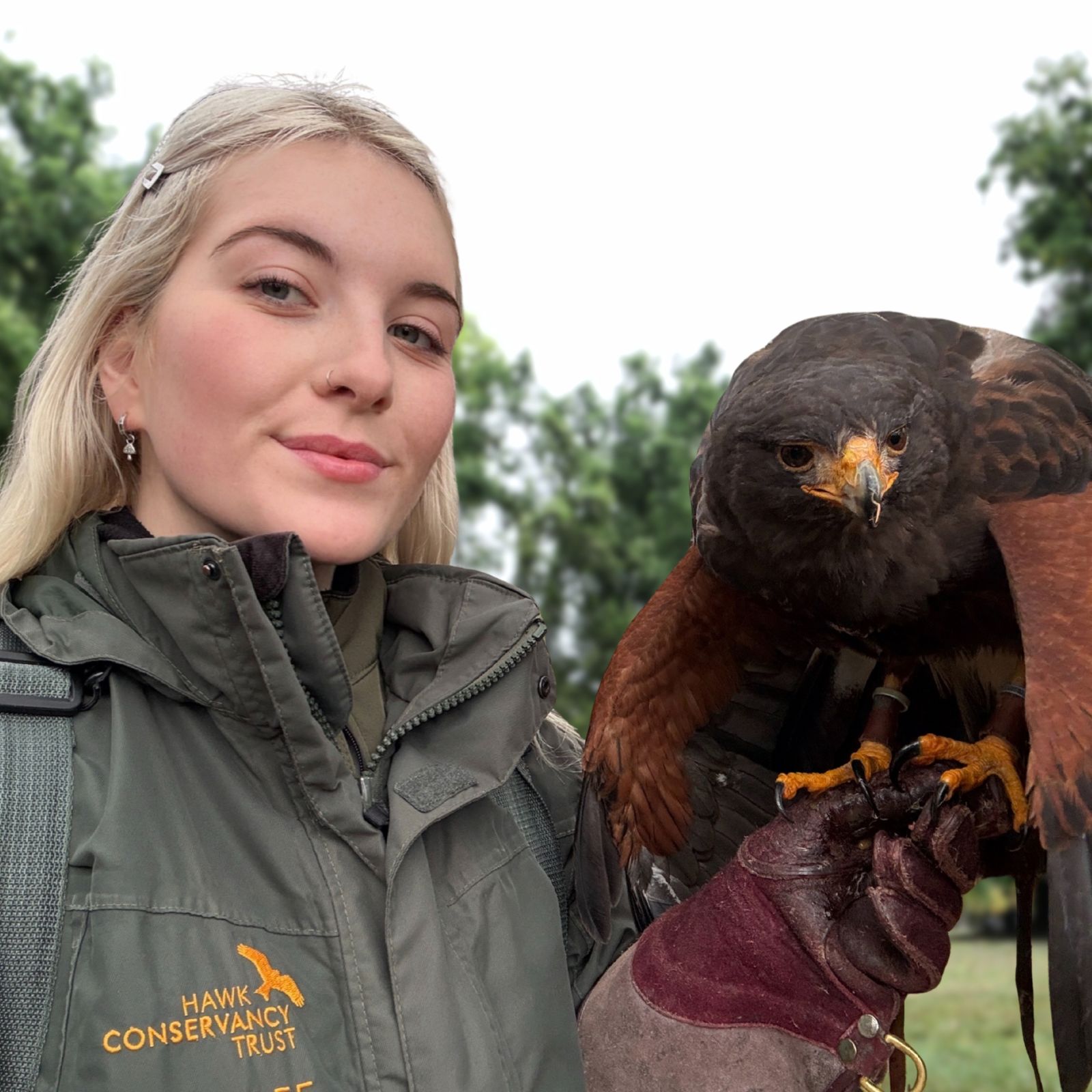
In September 2025, Bird Team member Poppy was introduced to Phoebe, one of our Harris’ Hawks. When our Head of Animals, Tom asked if she would like to be the person to work most closely with Phoebe, Poppy jumped at the opportunity. Her role would be to build a relationship with Phoebe, prepare her for our “World of Birds of Prey” display during the winter season, and introduce her to visitors during our experience days.

“I was so excited. I’ve always had a massive soft spot for hawks, especially Harris’ Hawks, and I’d never worked with a female Harris’ Hawk before. I couldn’t wait to get started.”

Poppy was delighted to discover that she and Phoebe were the same age.

“There’s always something quite bizarre about working with a bird who has experienced the same number of springs, summers, autumns and winters as you have.”

Earning trust

As with all birds of prey, the first step is building trust. Developing that bond requires patience, consistency and understanding and for Poppy and Phoebe, those early days were far from straightforward.

“Phoebe was very unsure of me. It took her some time to even hop onto my glove to take her dinner.”

With plenty of patience, and more than a few moments spent standing perfectly still, Poppy gradually earned Phoebe’s trust.

“I still remember the day she finally came over and sat on my glove. I couldn’t stop myself from smiling. I knew then that this was going to be a very exciting journey for both of us.”
 

A star in the making

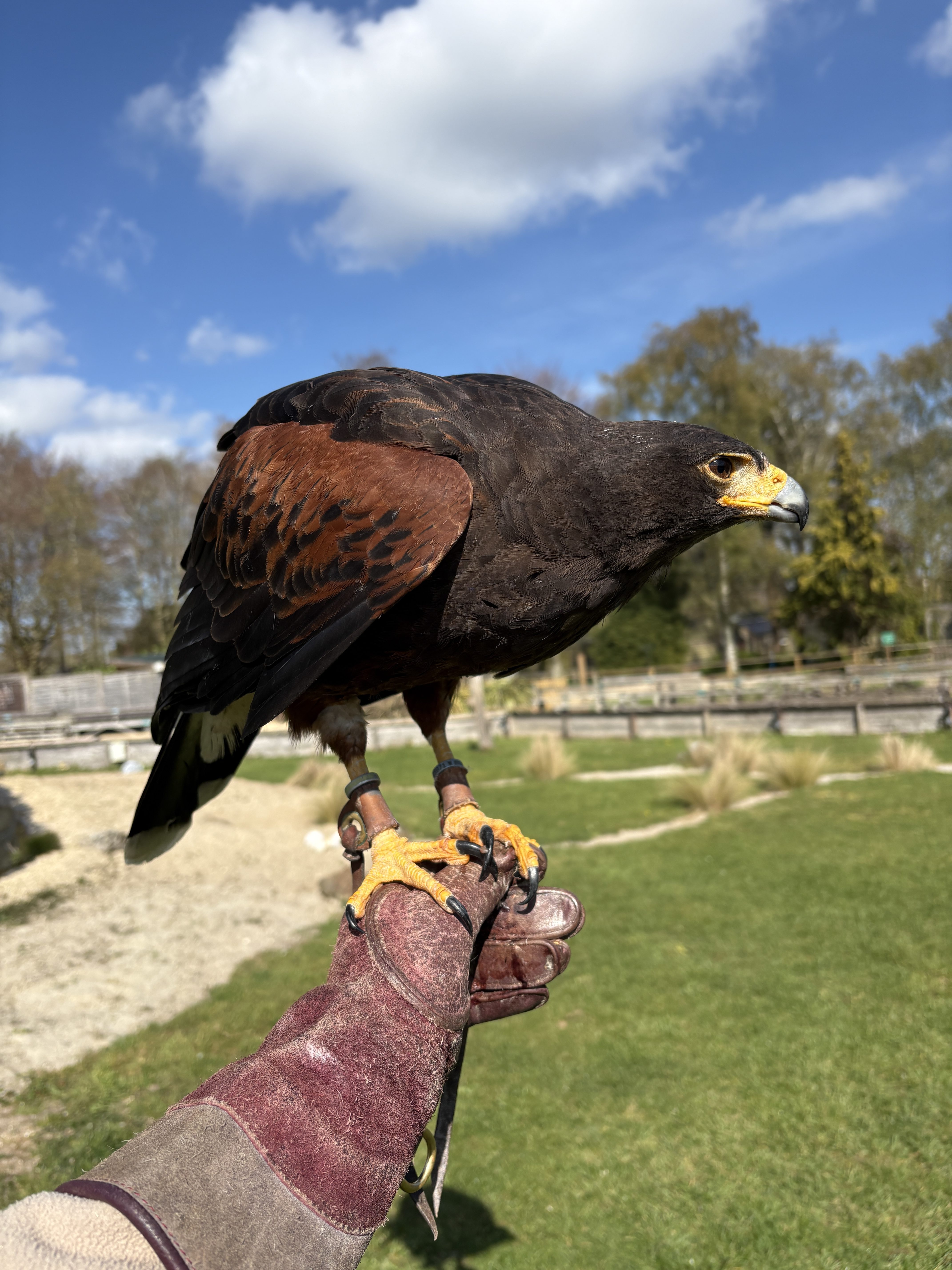
As their partnership grew, Poppy began taking Phoebe out into the Savannah Arena to continue her training. It was here that Phoebe’s confidence really began to shine.

“She looked absolutely gorgeous beneath the autumn sunshine. Her beautiful Harris’ Hawk feathers were striking in the light, and her big, kind brown eyes glistened as she looked to me for any sign that I was about to call her over to the glove.”

A special bond

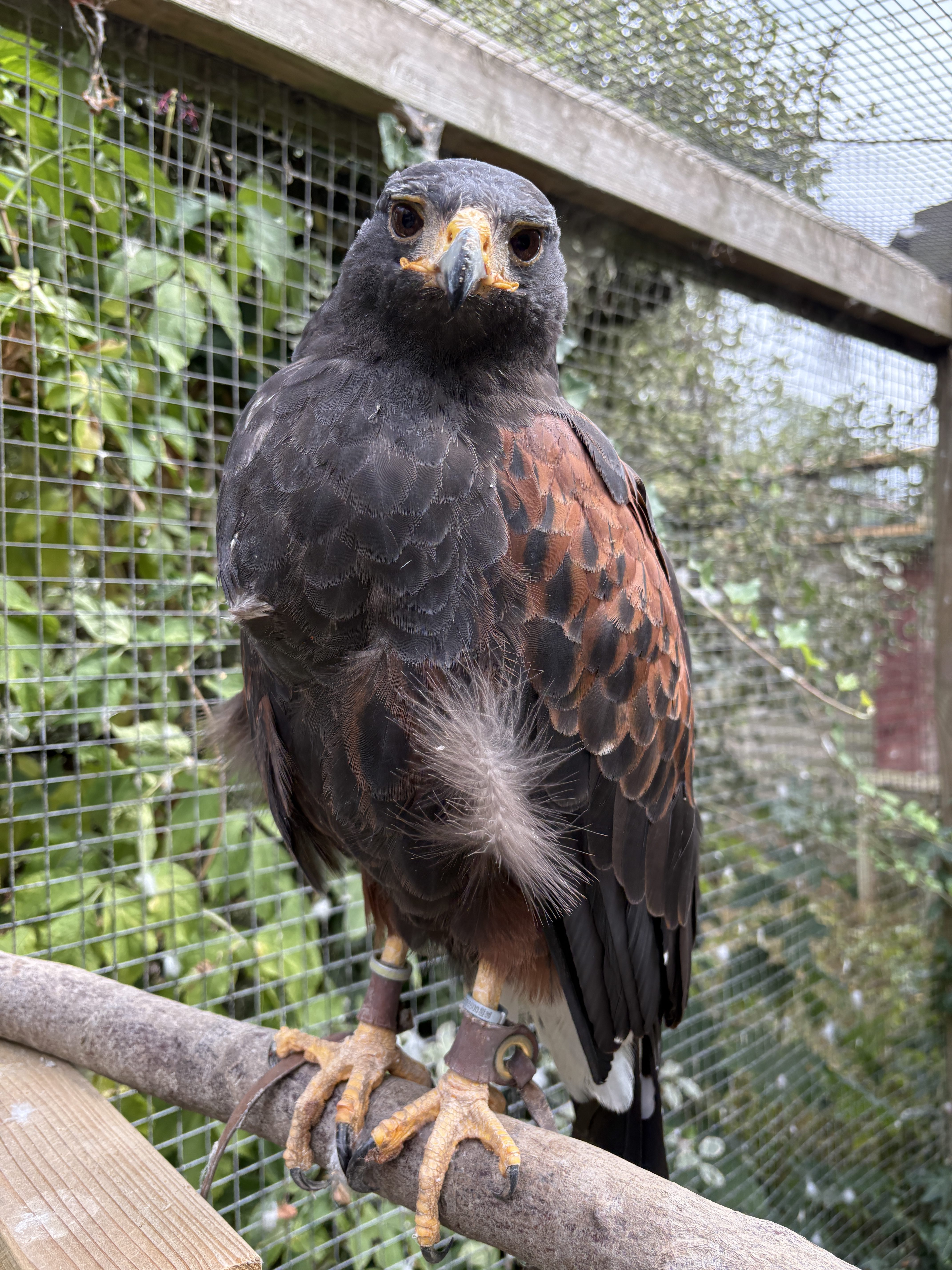
The pair quickly developed a strong connection, learning to read one another’s body language and cues. Although Poppy has worked with birds of prey for several years, she says she has never met a hawk quite as vocal as Phoebe.

“The second she hears my keys jingling on my belt as I walk around the corner, she hops to the front of her aviary and starts squeaking excitedly, mixed with her happy Harris’ Hawk grumbles. It’s one of my favourite sounds in the world.”

Today, the progress they have made together is clear for all to see. Phoebe has become a favourite among visitors and staff alike, both for her beautiful flights and her friendly personality. Guests can now see her during our World of Birds of Prey display, which will return as part of our winter timetable, and she regularly meets visitors during experience days.

Reflecting on their partnership, Poppy said:

“Harris’ Hawks are such naturally social birds. Unlike many other birds of prey, they often live and hunt cooperatively in family groups known as casts. They are highly communicative and often rely on those social relationships, which makes the connection I’ve been able to build with Phoebe feel even more meaningful to me.”

A clever hawk

Working with a Harris’ Hawk isn’t just about flight. These intelligent birds also need regular activities to challenge their minds and encourage natural behaviours.

One of Phoebe’s favourite activities involves a problem-solving exercise using cups and hidden treats.

“Harris’ Hawks are incredibly clever birds, so we began some fun exercises using cups. Starting with clear cups, I would place Phoebe’s favourite treats underneath them. The first time I tried it, she wasn’t impressed and didn’t understand what I was asking her to do. However, after I demonstrated by lifting the cups myself, she quickly began to make the connection.

Eventually, I swapped the clear cups for coloured ones that she couldn’t see through, and it was so rewarding to watch her work it out. Within seconds, she knew exactly what to do. Harris’ Hawks clearly possess a strong understanding of object permanence, and it was so exciting to explore another layer of Phoebe’s intelligence.”
Looking into the future

From those early days of cautious introductions to becoming one of our rising stars, Phoebe has come a long way. With Poppy by her side, she continues to grow in confidence, delighting visitors and showcasing the intelligence and beauty of Harris’ Hawks.

We look forward to seeing more of Poppy and Phoebe this winter. Book your next visit to catch them in action during our World of Birds of Prey display, where Phoebe’s stunning flight is sure to leave a lasting impression.

Newly Tagged Vultures

Posted on: by

At the end of July, the team travelled to Uzbekistan to complete the annual fieldwork for our Central Asian Vulture Project. This year’s focus was to tag more juvenile Egyptian Vultures with GPS trackers. This involves locating nests and within that, nest with birds at the right stage of development – both elements of which are no mean feat!

The team set out from Tashkent, covering over 3,000km in just six days of fieldwork, travelling across the Kyzylkum Desert in search of active nests. In these remote desert landscapes, Egyptian Vultures’ nests are often found in crags and holes on low hills and small riverine cliffs. The first nest of the season was found in the Arystanau Hills, just two metres above the ground on a small cliff face and home to just a single chick. Egyptian Vultures typically lay one or two eggs per clutch, so lone chicks like this aren’t unusual to find. There have been occasional observations from various parts of the world of three eggs being laid, a number rarely associated with vultures, and in exceptional circumstances – all three fledging, but this is far from the norm.

Other nests prove a far greater challenge and much more demanding to reach. Indeed, among this year’s nest finds, several were found tucked away near the top of scree slopes and rocky outcrops in the Bukantau Mountains, which required careful climbing to access them safely.

The stage of development of a chick is also an important factor in terms of attaching trackers, as Dr John Burnside from our partners Central Asian Vultures (CAV) explains:

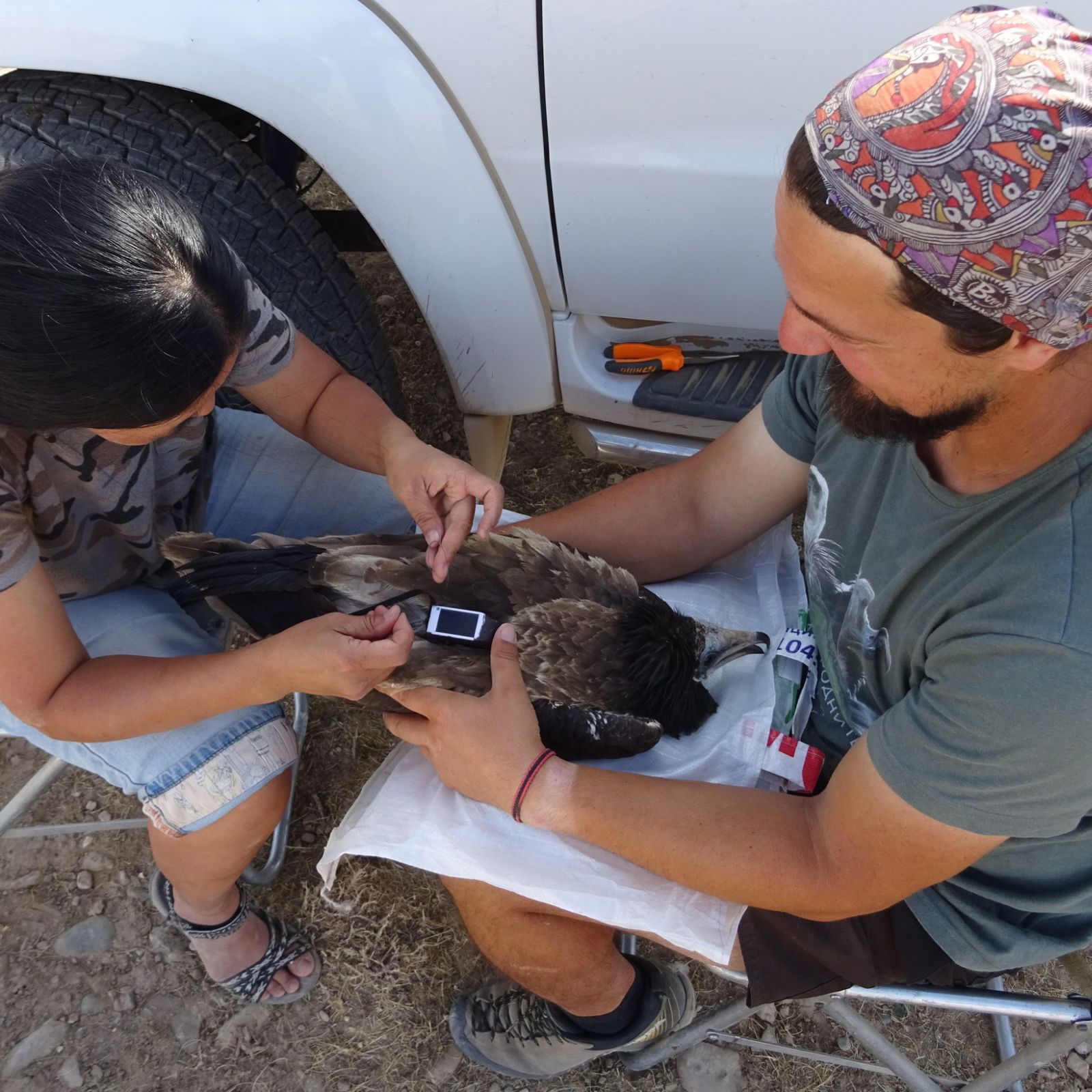
“Chicks are ideally tagged just days before fledging. At this stage they’re nearly full adult size (weighing around 1.6kg), though still in juvenile plumage, and once they do leave the nest they tend to stay close by. One of the risks of tagging juveniles this close to fledging age though, is that the chicks can sometimes leap from the nest prematurely due to the disturbance. Whenever this happens, the priority is to return the chick safely to the nest because if birds remain on the ground, they are vulnerable to predation. During this season we had two chicks leap from the nests, but the team moved quickly to recapture both chicks, before tagging them and replacing them safely back in their nests. Adults will continue to feed juveniles for several weeks after fledging, and it’s not uncommon to see a parent nearby during a nest visit.”

This year, the team also located two nests that both contained two chicks. The first nest was in Navoi, located in a river channel, which had two well developed healthy chicks, almost ready to fledge. In contrast, in Bukantau, a nest containing two chicks had one healthy full-grown chick and one underdeveloped chick that weighed only 700g. It is likely that the food availability in that area was not enough to support the growth of both chicks, although there could also be other health issues we are not aware of that might have contributed to this difference.

Over the last three years, the Institute of Zoology (IoZ) in Uzbekistan has been an important in-country partner supporting the CAV field team and the project more widely. During this time, the collaboration has not only helped facilitate fieldwork and outreach in Uzbekistan, but has also provided an opportunity for valuable skill-sharing and capacity building to occur. Through working alongside the CAV team, IoZ colleagues have been able to gain valuable experience and take away key learnings to develop their skills and own project work. The CAV team helped train two more IoZ staff this year in the complete process of fitting tags, including the preparation of the tags and harnesses, programming and testing the transmitters and the safe handling of the birds while fitting the trackers as required.

Developing local expertise is a key part of ensuring ongoing success of conservation efforts. By combining the experience and expertise of teams working across Central Asia, partnerships such as that between IoZ and CAV is helping to build the capacity needed to continue monitoring vultures and other species in Uzbekistan long into the future.

Including tags deployed by the IoZ team, a total of seven Egyptian Vultures were tagged in the 2026 field season. This latest fieldwork brings the project’s total to 29 tagged individuals since the beginning of the project with 21 active individuals still being monitored, with tags from partners in Kazakhstan providing further important data.

Continued tagging and monitoring are essential to conservation planning and have proven to be the most effective way of tracking individual birds across the vast, remote regions of Central Asia. A sufficiently large sample size is critical for drawing robust conclusions about key migration routes and important sites, while maintaining a strong sample across multiple years is equally important for monitoring threats as they shift across space and time. So far, the birds we have tagged appear to follow two broad journey routes. Most migrate to northern India and southern Pakistan, along routes where we have already identified significant bottlenecks and other heavily used areas that may warrant protection. A handful of birds, however, have travelled westwards towards East Africa and the Arabian Peninsula. These less frequent movements highlight the need to tag many more birds so that we can determine how representative these routes are. Are these individuals simply getting lost or taking an unusual route or becoming displaced from their typical migration path, or do these movements represent established routes used by a portion of the Central Asian population that we have not yet sampled sufficiently to detect? At present, there are several plausible explanations, but we need more data to distinguish between them.

Building this understanding is a vital first step in assessing threats and developing effective conservation measures. Greater certainty around the routes to South Asia has helped identify key sections of the migration pathway that may require protection and the conservation actions most likely to be effective there. The same applies to wintering grounds: by identifying where birds spend most of the winter and why they favour certain locations, we can ensure these sites are safe and identify other areas with similar characteristics that may also need safeguarding. These are steps we would also want to replicate if birds travelling west to the Arabian Peninsula and East Africa are not simply taking a wrong turn.

In vulture populations elsewhere, satellite tagging has proved invaluable in revealing movements, identifying important sites and migration bottlenecks, and helping to identify threats and causes of mortality. The goal for this project is to use the data generated to provide valuable insights as the work progresses from understanding where these birds move, to identifying the threats they encounter along the way, and ultimately informing measures to help protect them.

©2026 Hawk Conservancy Trust