





Dr Jamie McKaughan, our Conservation and Research Coordinator, cracks open the myth surrounding Kestrels and how they hunt their prey, separating fact from fiction and revealing what the science is really telling us…
When better evidence comes along, it should update our knowledge and our thinking, but sometimes our collective memory does not always keep pace, or perhaps the new evidence does not get the public spotlight it should – another discussion for another time perhaps!
Nonetheless, ideas that have never been properly demonstrated, tested or proven can become so deeply embedded in popular understanding that years of repetition give them an authority they never earned, sometimes even allowing them to survive a robust scientific study that has directly challenged or disproved them. The result is a strange inversion: common belief being more persistent than empirical evidence. Even if you ask an AI system, it is likely these very same inherited assumptions are confidently repeated rather than any reflection or credence given to the robustly tested published research that overturned it…
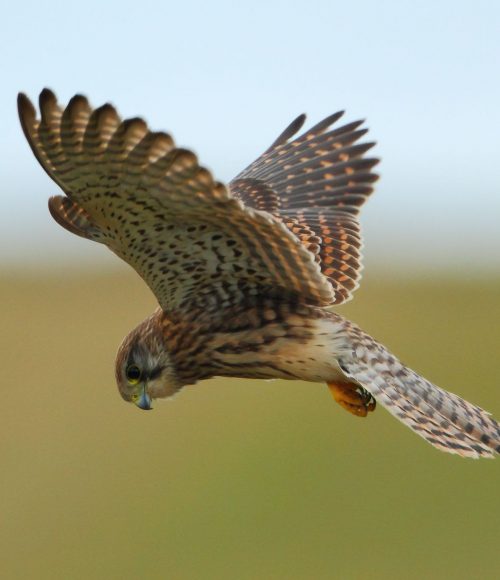
So, where am I going with all this?! There are many examples of this scenario regarding wildlife, but a prime example comes in the form of Kestrels, and the idea that they use urine trails to help them hunt their prey – 100 percent, right? Wrong! A piece of research by Olle Lind and team set about testing this theory properly, with their comprehensive results published in 2013, coming up on 15 years ago now…
This myth originated from two circumstantial pieces of information being put together with an assumption they were related without ever being tested… Point Number One – birds’ vision is sensitive to UV light and point Number Two – a finding from Finland that urine of Finish voles reflects UV light.
Let’s break those two points down… are they even true and are they actually related?
Let’s start, logically, with point Number One – birds’ vision is sensitive to UV light. We widely accept that many birds are what are called tetrachromats, where they possess a fourth specialised cone type in their eyes that detects ultraviolet or violet wavelengths of light. For comparison, humans are trichromats, possessing only three types of colour-receptive cones in our eyes (blue, green and red). The extra colour-receptive cone that many birds have allows them to experience a world of colour humans cannot perceive. As the feather structures of many bird species also reflect light in the ultraviolet or violet range and because many birds can discriminate this greater variety of colours than humans it is likely that birds will appear quite differently to each other than they do to us. So, part one of our myth, thus far, is giving truth vibes… However, that is just part of the tale…
The 2013 study that disproves this entire myth tested the specific wavelengths of light that actually make it to the retinas of several species of raptor. Before light hits the retina, it is filtered through the cornea, the lens and the fluids in the eye, all of which could impact what amount and/or wavelengths of UV actually reach the retina – something their research showed to be true. They found that a lot of UV light was filtered out, with only much higher wavelengths reaching the retina. As such, in order for Kestrels to be hunting voles by following their urine trails they would need the vole urine to be reflecting the higher wavelengths of UV light…
So, what wavelengths might vole urine be reflecting if any?…
To address point Number Two – that urine of voles reflects UV light – the same 2013 study tested the amount of UV light that vole urine reflected. In a contrast to the idea from many years before that Finish vole urine reflects UV light, their findings showed there was very little if any UV light reflected, with many other studies also studying mammalian urine and finding no UV is reflected, with it effectively appearing the same as water would – pretty robust and conclusive! If there is no UV being reflected by vole urine (which there isn’t!), Kestrels cannot be using it as a means to hunt said voles!
So, despite the long-standing claim that Kestrels use vole urine trails to locate their prey being a compelling ecological story that has persisted in popular and even scientific discourse for decades, and a narrative that still seems to remain, it is not true! Now we just need to dispel this commonplace myth more widely… If you hear someone saying that the Kestrel’s superpower is hunting voles by following their UV-reflecting urine trails, be sure to let them know this is not true… science says so!
My final reflection is about how we perceive species and their ‘value’… I often hear Kestrels being hailed as awesome because of this mythical hunting superpower, and it strikes me as curious that we would think their achievements are more awesome because of this supposed ability than without it. If anything, I think they become even more wondrous by being able to hunt successfully in the way they do in the absence of this ‘special ability’ in their arsenal… They are super enough as they are and that is just one reason we are working so hard to conserve them!