





Dr Jamie McKaughan, our Conservation and Research Coordinator, was asked whether there might be a connection between some raptors’ colourful facial markings and their tendency to hunt snakes, it sparked a fascinating journey of enquiry. So he set out to investigate the science behind their striking looks for us…
I was recently asked why some raptors have colourful facial markings, and whether there might be a connection between these markings and the fact that many of these birds also hunt snakes. Could the two be linked? It was an intriguing observation, and although I offered a fairly quick answer at the time, the question has stayed with me. I have found myself returning to it several times since, prompted by a few broader thoughts: how scientific enquiry takes an idea from hypothesis to established fact, and how the things we learn early in life can shape our understanding long afterwards. Sometimes, it seems, a broad generalisation absorbed in childhood can prove surprisingly persistent, even when more precise knowledge acquired later ought to lead us to think differently.
From a young age, certainly here in the UK, we are taught certain things that are supposed to help keep us safe. One that immediately springs to mind concerns the black-and-yellow buzzing variety: if it has bright yellow and black colouring, it is warning you to keep your distance, not to touch it, and certainly not to annoy it! As we get older, many of us begin to refine this rather broad rule. Bees are black and bright yellow, but they seem like friendly folk; they typically die after stinging, so perhaps we should give them a helping hand. Wasps, on the other hand, we often say are grumpy and aggressive, and there are the pretenders like Hoverflies, that sport similarly bright colours but lack the sting or bite to back them up, but perhaps still an effective survival strategy. Of course, we tend to know that these characterisations are our own making. Bees, wasps and their imitators are not consciously playing the roles we have assigned them; they are simply going about their business within the wider workings of nature. Yet we seem quite happy to carry these simplified ideas around with us, even as our understanding becomes more nuanced.
So, why am I rabbiting on about bees and wasps, and what has any of this got to do with birds of prey? Well, I wonder whether a similar association of ideas might be at work when we consider the previous observation – the colourful faces of certain raptors and their apparent tendency to hunt snakes. We are familiar with the idea that bold, contrasting colours serve as a warning, signalling danger to anything that might approach too closely. But perhaps, in this case, that familiar lesson is being applied in a different context. Rather than being the colours of an animal warning off a potential predator, could they serve some purpose for a bird that is itself the hunter? It is an intriguing possibility, although one that would need evidence before we could draw any firm conclusions and are there other explanations for the association?
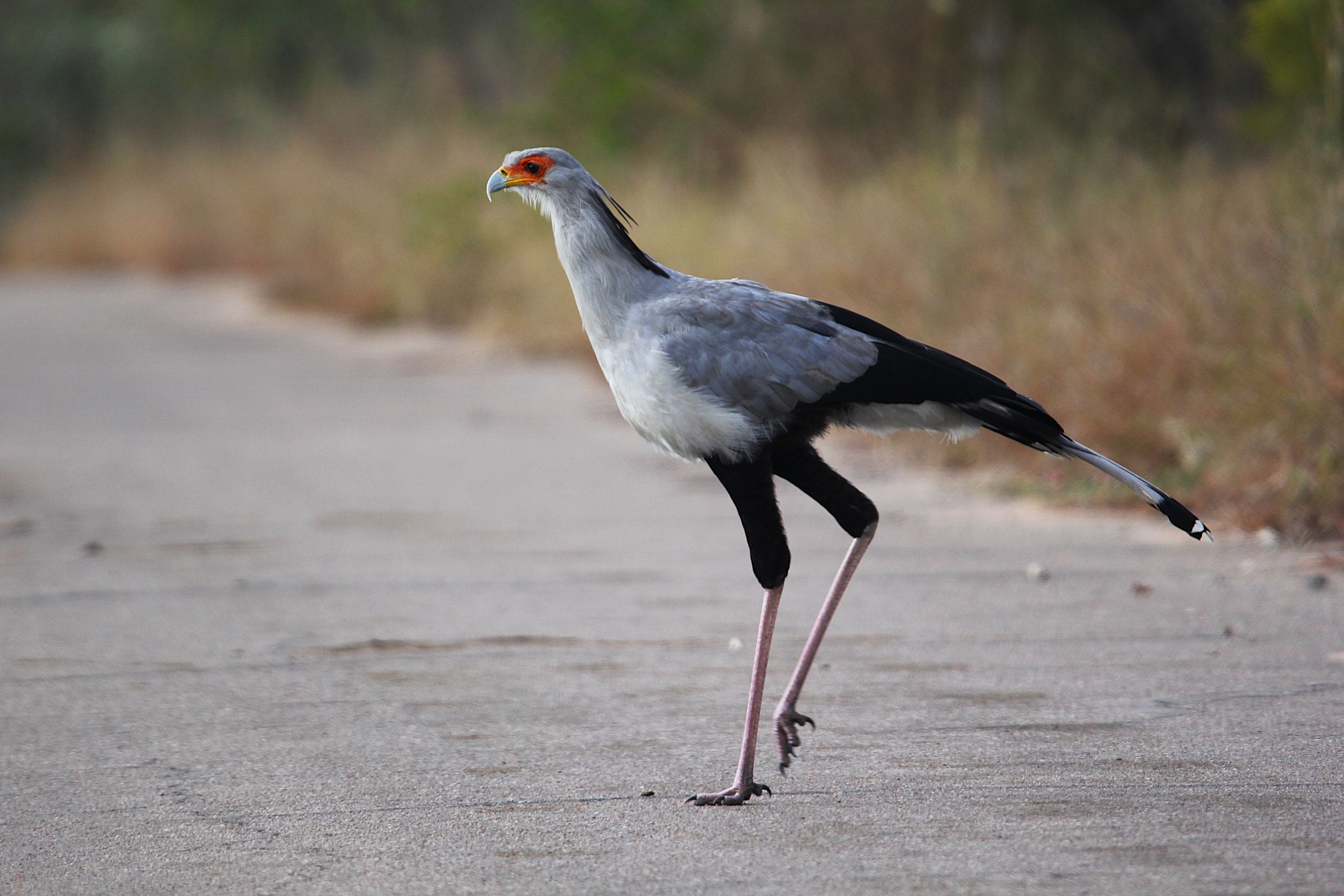 So, who are some of the birds that might fit this brief? Probably the most obvious one of course is the Secretarybird. Famed for its ability to dispatch deadly snakes with their incredible kicks with the power of about 5x their body weight, they have beautiful, colourful faces of yellow, orange, peach and red hues. Moving continents, the Crested Caracara has a wonderful punchy orange colour to their faces, that can change colour. They most certainly can fly but are commonly found scooting around at ground level on their feet – a rather more likely way of confronting a snake! Then of course, there is Africa’s ‘tightrope walker’ – the Bateleur, often seen with a snake in its talons, with their stunning flushed red faces. No doubt there are others…
Let’s start with the first part of the equation – snakes! What awesome creatures. Some can strike at incredible speeds, with the Puff Adder, one of Africa’s most venomous snakes, capable of striking faster than a human can blink. So, if you’re a raptor attempting to catch one of these potentially dangerous prey items, you might think that having an extra little something to discourage an attempted bite could be rather useful. But there’s a fairly important question to consider: can the snakes even see these colours, and would they make any difference?
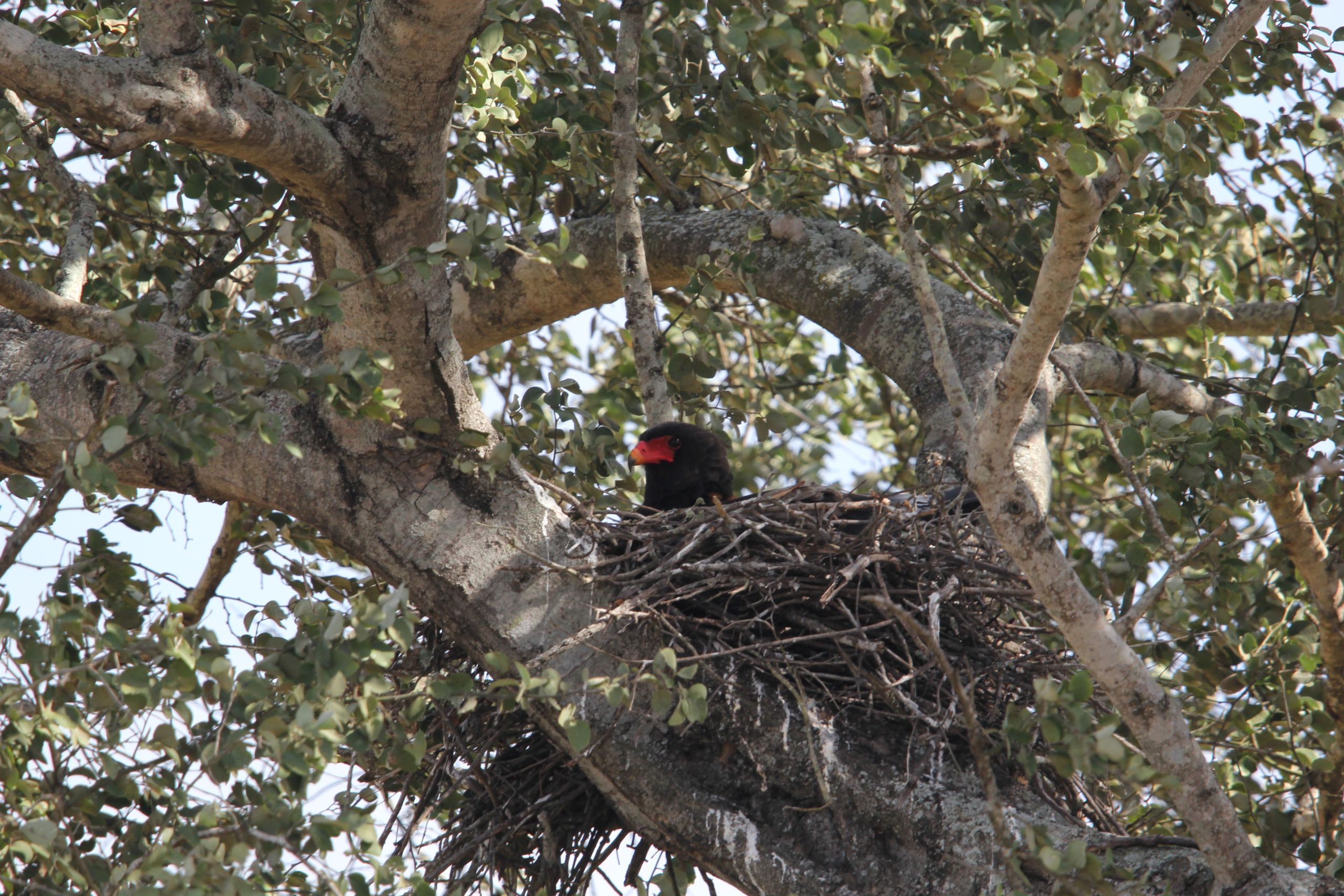
Snake vision varies between species, but many have dichromatic vision, which means they can distinguish colours along two visual channels rather than the three available to most humans, essentially seeing things in greens and blues. This means that the colourful faces we see on these birds may look rather different to snakes. Whether those colours would still make the bird’s face stand out against its surroundings, or perhaps create a different kind of visual signal altogether, is hard to say, but we certainly can’t assume that a snake sees the same bright warning colours on these raptors’ faces that we do. In fact, there may be an even bigger problem with the idea. Some raptors, such as Bateleurs, can alter the intensity of their facial colouration through changes in blood flow. Meanwhile, certain snakes, such as pythons, possess heat-sensitive pits around their snouts that allow them to detect thermal radiation – pretty cool. Now, if you’re a raptor making your face more conspicuous by pumping extra blood to the surface, you are likely also making it warmer. Could that potentially make your face a more obvious target for a heat-sensitive snake defending itself? It is then perhaps not quite the advantage we had in mind! Of course, whether any such temperature change would be detectable or relevant to a striking snake is another question. Regardless, taken together, these points leave us on rather shaky ground if we want to argue that colourful faces evolved to help raptors deal with dangerous snakes, but let’s now consider those exceptions I mentioned earlier.
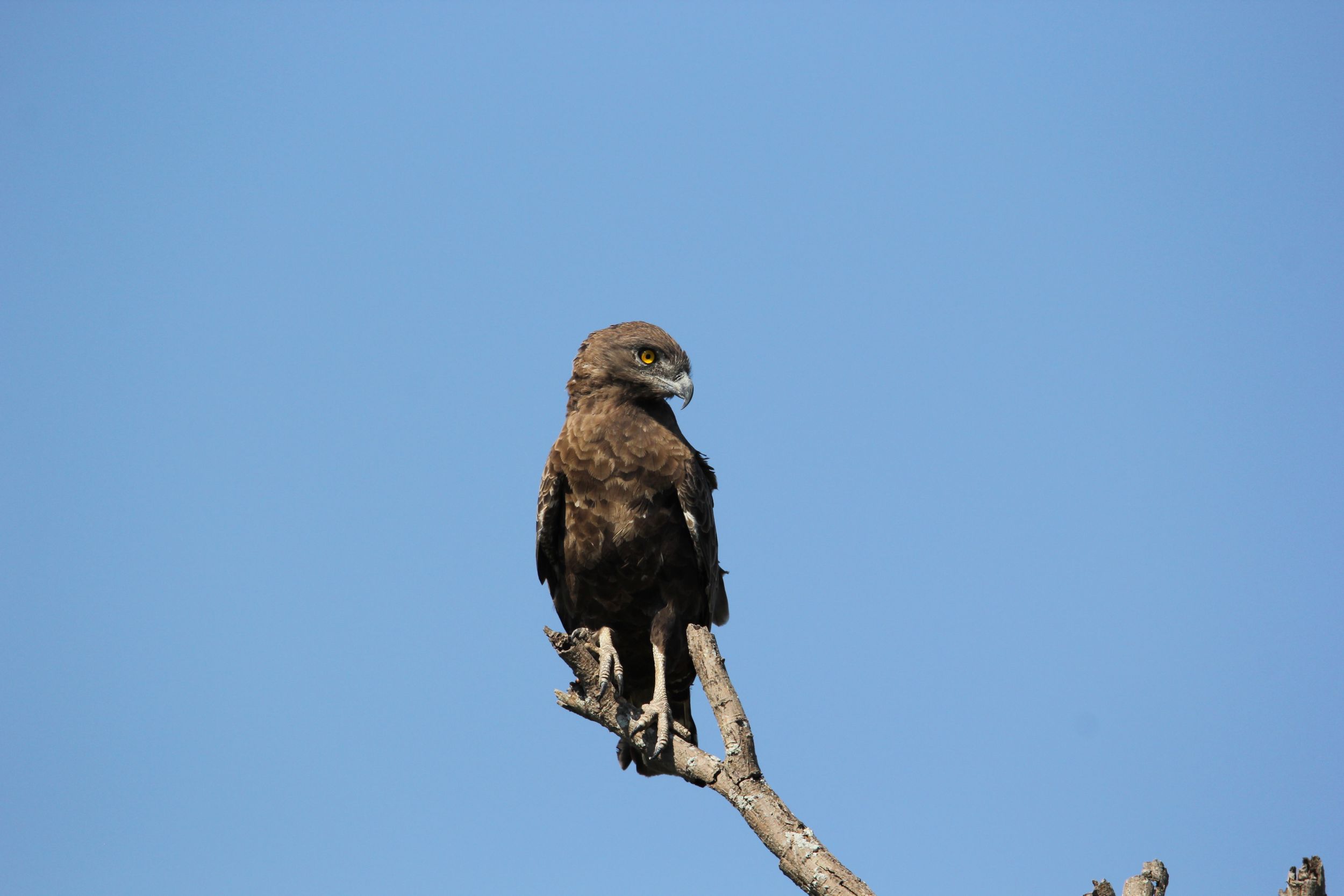
Perhaps the most relevant group of birds to this whole conundrum is… the snake eagles, of course! These birds belong to the genus Circaetus and are found predominantly in Africa, although the group’s distribution extends beyond the continent. It is fair to assume that their name isn’t ironic, with snake eagles being among the most accomplished raptors when it comes to catching this particular prey. While Bateleurs are often talked about in the same bracket, they are not part of this group, and interestingly, in the context of this discussion, would actually be the facially coloured anomaly if they were, because here’s the thing: snake eagles, like the Brown Snake Eagle pictured here, lack the conspicuous facial colouring seen in the other raptors we’ve been discussing. Yet they are exceptional hunters of snakes. Perhaps their specialised hunting techniques mean they have less need for any additional deterrent. Or perhaps, and seemingly more likely, those colourful faces were never primarily about hunting dangerous snakes in the first place…
This brings me back to the other thought that has stayed with me since that conversation – the nature of scientific enquiry itself, and how it begins. In a small way, what we have done here reflects that process. We notice two things, begin to wonder whether they might be connected, and develop an idea about how one might explain the other. There is nothing wrong with that; in fact, it is often precisely where scientific discovery begins. The important part comes next: testing the idea to see whether the evidence supports it, something we are stringent advocates of here at the Trust, rather than simply accepting the connection because it seems to make sense. One such example was perfectly captured in one of our recent blog posts debunking the myth that Kestrels use ultraviolet trails left by small mammals to help locate their prey. The idea was plausible, the association was interesting, but plausibility alone was not enough, as the research ultimately showed.
And so, we return to our colourful-faced raptors. We have spotted a possible association between facial colouring and snake hunting, considered one way the two might be linked, and found reasons to question that explanation. We haven’t necessarily solved the mystery of those colourful faces, something we can explore more in future perhaps, but we have still done something useful by beginning to separate what we observe from what we assume, and what seems plausible or even reasonable from what the evidence might actually tell us.
A bit of a different tale about the birds and the bees than some might have come to expect… but probably for the best… we can look at breeding seasons another time!