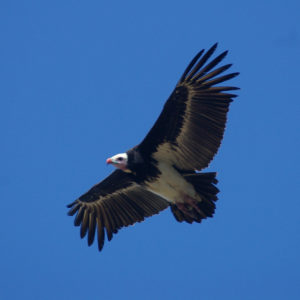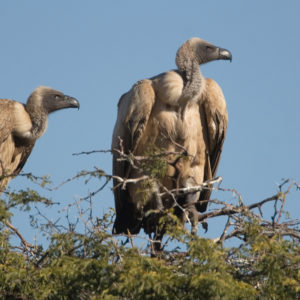





Vultures as a group are the most threatened birds in the world. Of the 23 species of vultures in the world, over 70% of them have an unfavourable conservation status, meaning that they’re at risk of going extinct.
In 2015, our Head of Conservation and Research, Dr Campbell Murn, and Africa Projects Manager, André Botha, were co-authors on a paper that led to the uplisting of six of Africa’s eleven species of vulture to critically endangered. The paper, Another continental vulture crisis: Africa’s vultures collapsing toward extinction, showed that Africa’s vultures are facing a range of specific threats, the most significant of which are poisoning and trade for belief-based uses, which together have accounted for 90 per cent of reported deaths. A follow-up paper in 2024, also co-authored by André and Campbell, highlighted the wider problem for Africa’s savanna raptors as a whole, and reiterated the poor situation facing Africa’s vultures.
Since these two papers were published, the Hawk Conservancy Trust has worked tirelessly to improve African vultures’ chances of survival. Poisoning remains the biggest threat facing vulture populations in Africa, with the slaughter of elephants by poachers contributing significantly to the issue – nearly one third of all vulture poisonings since 1970 have been connected to elephant poaching in some way.

The African continent is being poisoned at the moment, from the smallest invertebrate to the largest elephants. Watch this video to find out more.
Vultures are vitally important ecologically and further losses of populations will be devastating to the African continent. Watch this video to find out more.
We need your support to help in the fight to prevent vultures from going extinct. Watch this video to find out more.
In response to research by Campbell and André (read more below), the Trust developed a Poison Response Action project, training field staff in high-risk areas on how to use Poison Response Kits designed to manage and reduce the impact of poisoning attacks.
The threat of poisoning remains the most serious concern and is the biggest problem affecting vultures in Africa, still largely related to ivory poaching, with several major poisoning incidents making international news in the summer of 2025. Despite this ongoing challenge, this project has achieved remarkable growth and impact. What began with us creating and distributing Poison Response Kits (PRKs) and providing training to park and reserve staff has evolved considerably. As awareness of the vulture crisis has increased, so too has the commitment of protected areas to respond effectively. Many parks and reserves are now proactively requesting and independently funding both the training and the kits, with André travelling far and wide to provide training and support.
To date, the project has trained more than 7,000 field staff and rangers across over 20 African countries. With this rise in local ownership and preparedness, we are now able to redirect our resources toward supporting organisations that lack the means to fund training or kits themselves. This shift allows us to strengthen poison response capacity across a broader landscape, making efforts more resilient and far-reaching.
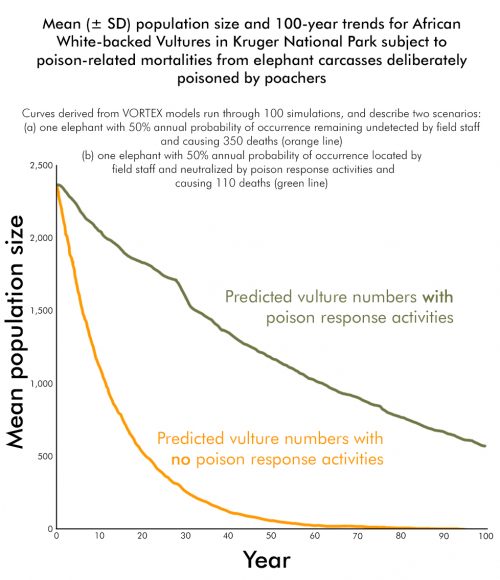
Research by Campbell and André, published in Oryx – the International Journal of Conservation – took the first steps towards assessing the risk from poisoning associated with elephant poaching (A clear and present danger: impacts of poisoning on a vulture population and the effect of poison response activities). Using a modelling programme called VORTEX, we assessed a population of Critically Endangered vultures being affected by poisoning.
The analysis showed that poisoning caused large population declines (50-100%) in almost all cases where it occurred. In more than one case, the average time to extinction was 50-60 years. The results show that carcasses of elephants killed by poachers and laced with poison are a clear and present danger; they will lead to local extinctions of vulture populations.
More encouragingly, the analysis also showed that where field staff are trained and equipped to neutralise poisoned carcasses and reduce poison-related mortalities, the probability of local populations going extinct is reduced significantly. These results drove the momentum towards providing Poison Response Kits and a training programme to field staff in high-risk areas in southern and south-eastern Africa. The work continues to be extremely important as it trains and equips field staff to deal with poisoning events when they occur.
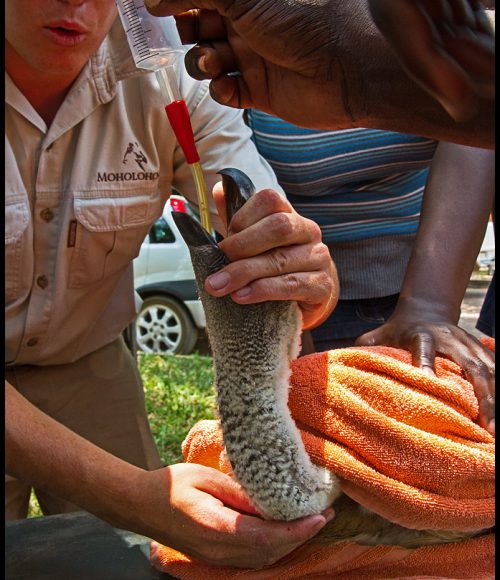
Photos by Andre Botha
Our follow up research, confirmed that we needed to take a targeted approach to conserve African vultures effectively.
This research investigated the survival rates of two vulture populations in South Africa: Kruger National Park and Kwazulu-Natal (KZN). The results showed that adult breeding birds had a higher survival rate in Kruger than in KZN at that time because Kruger has a higher level of protection and poisoning events were fewer. Kruger has since become another poisoning hotspot, suggesting that protected area status alone is not enough to protect vultures effectively from all the threats they face.
Nonetheless, our study highlighted the need to target conservation work, such as the Poison Response Action, in specific areas. We need to direct activities to areas of high conservation importance, such as breeding colonies and poisoning hotspots. Initiating Vulture Safe Zones might help enhance vulture protection in southern Africa beyond what is already provided in protected areas. Vulture Safe Zones are used successfully in South Asia, where our Pakistan Vulture Restoration Project is working to conserve Asian vultures.
Each poison response kit costs £300 and after a poisoning incident each kit needs to be replenished at a cost of £180. You can help us raise the funds needed to provide these kits that could save thousands of vultures and other wildlife from an unnecessary death due to poison.
Poison response kits contain a range of equipment and first aid materials and are designed to reduce the impacts of poisoned carcasses on wildlife. Often, poisons are so toxic that vultures can die with food still in their mouths. This means that work must take place as soon as possible to prevent further deaths. With a quick response and the effective use of Poison Response Kits, hundreds of animals can be saved from death by poisoning.
Each poison response kit costs £300 and after a poisoning incident each kit needs to be replenished at a cost of £180.
from just £3 a month, you can make a real difference.